
Yams in Igbo Culture
4 min read
Quick Overview
- Prep time
- N/A
- Cook time
- N/A
- Total time
- N/A
- Servings
- Cultural overview
- Difficulty
- N/A
- Cuisine
- Nigerian
Ask an Igbo elder what defines a good farming season, and the answer will almost always circle back to one crop: yam. In southeastern Nigeria, yam (ji) has functioned for centuries not just as food but as a currency of respect. A man's yam barn — the structure where harvested tubers were stored and displayed — told the whole village how hard he had worked and how well his ancestors had blessed him.
Why Yam Outranks Every Other Crop
Cassava, cocoyam, and maize all grow in Igbo farmland, but none carry the symbolic weight of yam. Part of this comes from difficulty: yam cultivation demands mounding soil into large heaps, staking vines, and tending the crop for eight to ten months before harvest. It is physically demanding work traditionally associated with male labor and adulthood. A young man's first successful yam harvest was historically treated as a rite of passage, proof that he could provide for a household.
Chef's Notes / Key Takeaways
- ▸Yam (ji) is historically the most prestigious crop in Igbo agriculture, tied directly to a man's status as a farmer.
- ▸The New Yam Festival, or Iri ji, marks the end of the farming year and the ritual first-tasting of the new harvest.
- ▸Pounded yam (ji akwu) is a labor-intensive dish traditionally made by pounding boiled yam in a mortar until smooth.
- ▸White puna yam and water yam are the two most common varieties, each suited to different dishes and textures.
- ▸Yam barns and yam titles historically signaled a family's wealth, discipline, and social rank within the community.
- ▸Modern Igbo households still observe yam traditions, though mechanized pounding and store-bought flour have changed daily practice.
Titles built around yam farming, such as Eze ji ("king of yam"), were awarded to farmers who produced exceptional harvests year after year. These titles carried real social currency, influencing marriage prospects, standing in community councils, and even burial rites.
The New Yam Festival: Iri Ji
The most visible expression of yam culture is Iri ji, the New Yam Festival, held between August and October depending on the town and its farming calendar. The festival marks the transition from the old farming year to the new one and centers on a simple but strict rule: no one eats the new yam harvest before the ceremonial first-tasting.
The event typically opens with a presentation of yams to the eldest man or traditional ruler, who offers a portion to the ancestors and deities before slicing and distributing pieces to those present. Only after this ritual can households begin cooking and eating from the new crop. Masquerade displays, drumming, and communal feasting usually follow, turning the occasion into one of the most anticipated events on the Igbo cultural calendar.
"You do not eat the new yam alone — you eat it after the elders have spoken to the land." — a common saying among Igbo farming communities describing the order of the Iri ji ceremony.
Beyond its religious dimension, Iri ji also functions as an agricultural checkpoint. It signals when farmers can safely clear old vines, prepare fresh mounds, and plant seed yams for the coming season, tying the spiritual calendar directly to practical farm management.
Pounded Yam: Ji Akwu
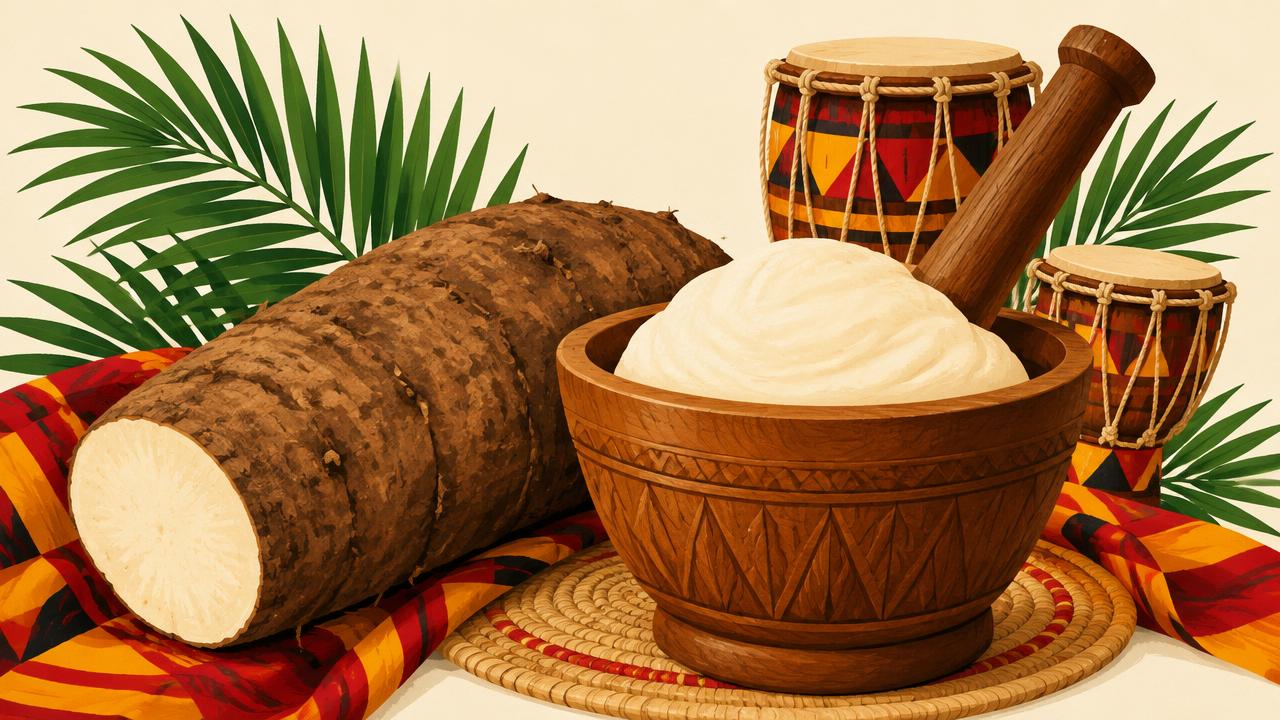
No discussion of yam culture is complete without pounded yam, known locally as ji akwu or simply utara ji. The dish begins with peeled yam chunks boiled until fully tender, then transferred to a large wooden mortar and pounded with a pestle until the mixture turns into a smooth, stretchy, dough-like mass. This is skilled, physically taxing work, traditionally done in rhythm by two people taking turns, or by one very strong cook.
Pounded yam is prized for its texture: dense but pliable, capable of being pinched off and used to scoop soups like egusi, oha, or bitter leaf soup without falling apart. Many households now use electric pounders or pre-made yam flour (poundo yam) to shortcut the process, but traditionally pounded yam remains the gold standard for special occasions, in-law visits, and festival meals.
Common Yam Varieties and Their Uses
Not all yams behave the same way in the kitchen, and Igbo cooks choose varieties deliberately based on the dish they intend to make.
| Variety | Texture | Common Use |
|---|---|---|
| White puna yam | Firm, dry, starchy | Pounded yam, roasted yam |
| Water yam | Soft, moist | Yam porridge (asaro), boiled yam |
| Yellow yam | Dense, slightly sweet | Porridge, festive dishes |
| Seed yam (small tubers) | N/A, used for planting | Next season's crop |
White puna yam's dry, starchy flesh holds together well under the pressure of pounding, which is why it dominates pounded yam preparation. Water yam, by contrast, has a higher moisture content that makes it porous and better suited to porridge, where it absorbs the flavor of palm oil, pepper, and stockfish rather than needing to hold a firm shape.
Yam Titles and Social Meaning
Historically, a household's yam barn was built prominently near the compound entrance, arranged with the largest tubers displayed at the front. Visitors could gauge a family's prosperity simply by walking past. Elders who accumulated large harvests over many seasons could take yam-related titles that granted them speaking privileges at community meetings and priority in dispute resolution.
This connection between yam and status persists in subtler forms today. Bringing yam tubers as a gift during traditional marriage negotiations (igba nkwu) remains customary in many Igbo communities, and the size and quality of the yams offered can still be read as a sign of respect and seriousness.
Yam Culture in Modern Igbo Life
Urbanization and imported staples have shifted daily eating habits, and rice or pasta now appear far more often on weekday tables than pounded yam did a generation ago. Yet the New Yam Festival continues to draw large diaspora crowds back to hometowns every year, and pounded yam remains the dish most requested at weddings, chieftaincy ceremonies, and homecoming celebrations.
For visitors trying to understand Igbo food culture, the yam offers a useful lesson: in many West African societies, staple crops are never just calories. They carry history, mark the calendar, and communicate status in ways that a simple ingredient list can never fully capture.
Related recipes
- A Typical South African Breakfast
South African breakfasts range from a quick rusk dunked in coffee to a full farm-style spread of boerewors, eggs, and pap. The common thread is heartiness: this is food built to fuel a long day of work outdoors, and it shows in the portions and the protein.
- How to Make West African Jollof Rice
Cook deeply flavored jollof rice with a pepper-tomato base, well-seasoned stock, and separate grains that absorb every layer. The guide explains the essential choices, common mistakes, and useful variations in clear practical terms.
- Ethiopian Injera and How to Eat It
Discover how teff injera is fermented, cooked, and used as both plate and utensil across Ethiopian and Eritrean meals. The guide explains the essential choices, common mistakes, and useful variations in clear practical terms.