
How to Cook Cellophane Noodles to Be Crunchy
4 min read
Quick Overview
- Prep time
- 10 minutes
- Cook time
- 5 minutes
- Total time
- 15 minutes
- Servings
- 4 as a garnish
- Difficulty
- Easy
- Cuisine
- Chinese
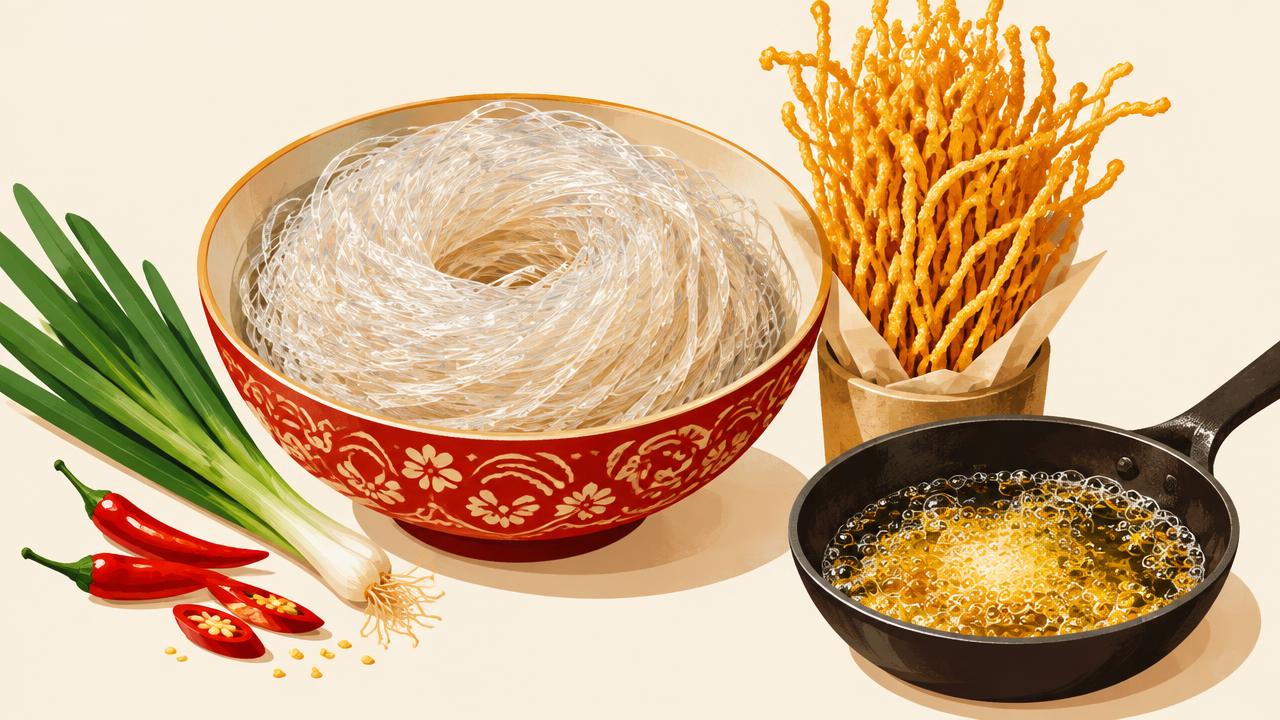
Cellophane noodles, sometimes called glass noodles, bean thread noodles, or fensi in Chinese cooking, are usually simmered in soups or stir-fries where they turn soft, slippery, and translucent. But there's a second life for these noodles that many home cooks never try: deep-fried straight from their dry state, they puff into a light, airy, genuinely crunchy tangle in a matter of seconds. It's the same principle behind the crispy noodle nests you might see under a plate of sweet and sour pork or as a garnish on a chow mein salad.
What Makes Cellophane Noodles Different
Cellophane noodles are made from starch, most commonly mung bean starch, though sweet potato and tapioca starch versions also exist. Unlike wheat noodles, they contain no gluten, which is exactly why they behave so differently in hot oil. When a starch noodle hits oil hot enough, the small amount of moisture trapped inside the noodle turns to steam almost instantly, and that steam has nowhere to go but out, causing the noodle to expand and puff into a crisp, hollow structure. This is the same reaction that makes pork rinds and some chip products puff when fried.
Chef's Notes / Key Takeaways
- ▸Cellophane noodles (also called glass noodles or bean thread noodles) fry crunchy only when they go into hot oil completely dry, never pre-soaked.
- ▸Oil needs to reach 350-375°F for the noodles to puff instantly instead of turning greasy or chewy.
- ▸A small handful of dry noodles expands dramatically, so fry in small batches to avoid oil overflow.
- ▸Drain fried noodles on paper towels immediately and salt them while still hot for the crispiest texture.
- ▸Crunchy fried cellophane noodles make an excellent topping for salads, soups, and stir-fries, similar to crispy chow mein noodles.
- ▸Store leftover fried noodles in an airtight container at room temperature; they stay crisp for about 2 days.
Because the reaction depends entirely on trapped moisture converting to steam, the noodles must go into the oil completely dry. If you soak them first, as you would for a soup or stir-fry, that path is closed off; soaked noodles will only turn soft and chewy in oil, never crisp.
Getting the Oil Temperature Right
Temperature control is the single most important factor in this recipe. Oil between 350°F and 375°F will cause the noodles to puff almost instantly, going from dry and brittle to light and crisp within 2 to 3 seconds. Too cool, and the noodles will absorb oil and turn greasy or chewy rather than airy. Too hot, and they will brown and turn bitter before they have a chance to fully expand.
The moment a dry noodle strand touches oil hot enough, it should turn from clear to opaque white almost instantly. That's your visual cue that the temperature is right.
A deep-fry or instant-read thermometer takes the guesswork out of this step, but you can also test with a single dry noodle strand: if it puffs and turns white within a couple of seconds without browning, the oil is ready.
Step-by-Step Method
Ingredients
- 4 ounces dried cellophane noodles (mung bean or sweet potato starch noodles)
- 3 cups neutral oil, such as peanut, canola, or vegetable oil
- 1/2 teaspoon fine salt, plus more to taste
- Optional: 1/4 teaspoon five-spice powder for seasoning
- Paper towels for draining
- A deep, heavy pot or wok
- Kitchen tongs or a spider strainer
- An instant-read or deep-fry thermometer
Method
- Break the dry cellophane noodle bundle into smaller sections, about 3-4 inches long, working over a bowl since they are brittle and can scatter.
- Do not soak or rinse the noodles; they must stay completely dry to puff correctly in the oil.
- Pour the oil into a deep, heavy pot or wok, filling it no more than one-third full, and heat over medium-high heat.
- Check the oil temperature with a thermometer; it should read between 350°F and 375°F before you add any noodles.
- Test with a single strand first: it should puff and turn opaque white within 2-3 seconds. Adjust heat if it browns too fast or barely puffs.
- Add a small handful of dry noodles to the hot oil at a time; they will expand rapidly into a light, airy tangle within 3-5 seconds.
- Immediately flip the noodles with tongs or a spider strainer to ensure even puffing on both sides.
- Lift the noodles out as soon as they turn fully white and crisp, before any part starts to brown, and transfer to a paper-towel-lined tray.
- Season immediately with salt (and five-spice powder, if using) while the noodles are still hot so it adheres.
- Repeat in small batches until all the noodles are fried, letting the oil return to temperature between batches.
- Let the noodles cool completely before storing or using, as they crisp further as they cool.
- Use within 2 days for the best crunch, stored in an airtight container away from moisture.
Troubleshooting Common Problems
| Problem | Likely Cause | Fix |
|---|---|---|
| Noodles turn chewy, not crisp | Oil too cool, or noodles were pre-soaked | Raise oil to 350-375°F; use only dry noodles |
| Noodles brown quickly | Oil too hot | Lower heat slightly and retest with one strand |
| Noodles are greasy | Fried in oil below 340°F | Let oil reheat between batches |
| Noodles go soft after cooling | Trapped steam under a lid or paper towel pile | Spread in a single layer to cool uncovered |
| Uneven puffing | Overcrowded pot | Fry smaller handfuls at a time |
How to Use Crunchy Cellophane Noodles
Once fried, these noodles are incredibly versatile. Scatter them over a chicken or shrimp salad for crunch, use them as a bed under a saucy stir-fry, or pile them on top of soups just before serving so they stay crisp against the broth. They also work well crumbled over rice bowls, or piled onto a plate of sweet and sour pork in the classic Cantonese-American style. Because they're neutral in flavor beyond a light salt seasoning, they pair with almost anything that benefits from a crunchy contrast.
Store any extra in an airtight container at room temperature, away from steam or moisture, and they'll stay crisp for about two days. If they do soften slightly, a brief 2-minute pass in a 300°F oven will usually re-crisp them.
Related recipes
- What Is the Difference Between Manapua and Steamed Pork Buns?
Manapua and steamed pork buns both trace back to Chinese char siu bao, but they've evolved into distinct dishes with their own size, texture, and place on the plate. Understanding the difference means understanding how Hawaii reshaped an immigrant dish into something entirely its own.
- Vietnamese Pho Herbs and Garnishes
A practical guide to the fresh herbs, citrus, chiles, and sauces served with pho, plus how to use each garnish without overwhelming the broth. The guide explains the essential choices, common mistakes, and useful variations in clear practical terms.
- What Is Korean Barbeque Marinated In?
Korean barbecue's signature sweet-savory flavor comes from marinades built on soy sauce, garlic, sesame oil, and often pureed fruit as a natural tenderizer. Understanding these building blocks lets you customize marinades for beef, pork, or chicken with confidence.