
What Kind of Bread Do I Serve with Moroccan Food?
3 min read
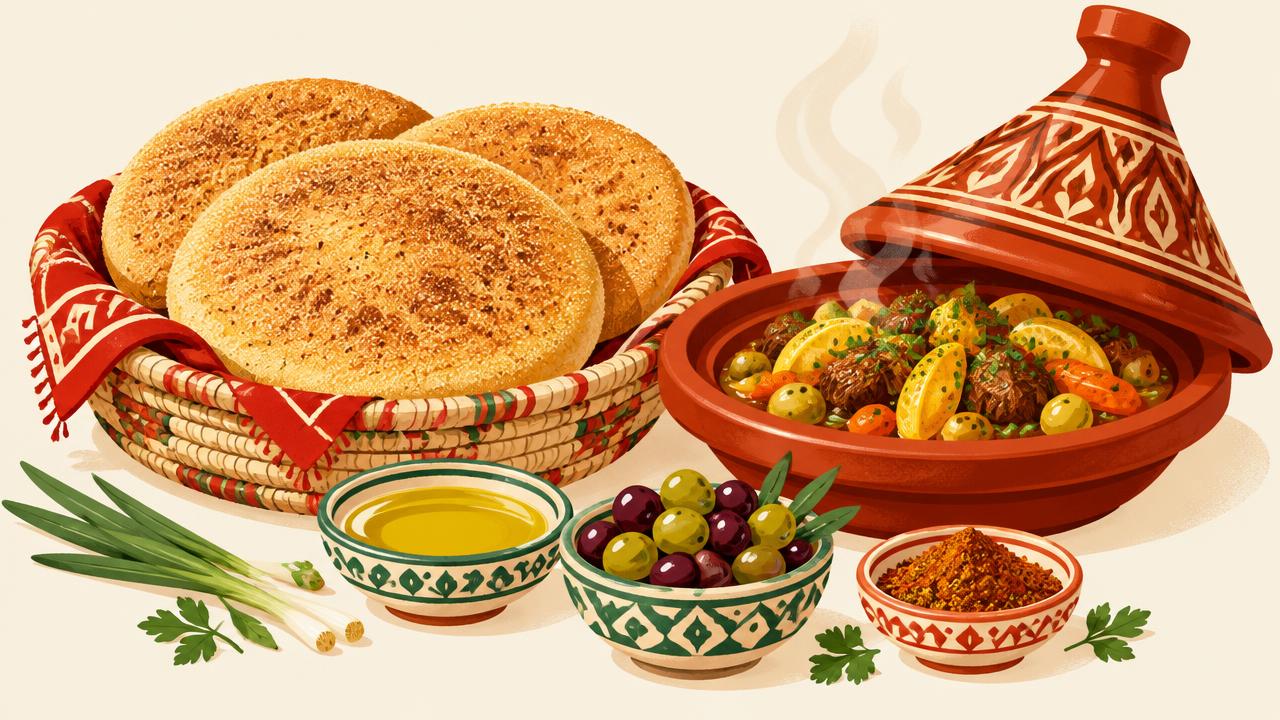
Quick Overview
- Prep time
- 20 minutes
- Cook time
- 25 minutes
- Total time
- 1 hour 45 minutes (includes rising)
- Servings
- 6 loaves
- Difficulty
- Easy
- Cuisine
- Moroccan
If you've ever sat down to a Moroccan meal, you've probably noticed there's rarely a fork in sight for the main course. Bread does the work that cutlery does elsewhere: tearing off a piece, folding it, and using it to scoop up stewed vegetables, saucy meat, or a smear of spiced dip. Choosing the right bread isn't a minor detail — it shapes how the whole meal is eaten.
Meet Khobz, the Everyday Loaf
The bread you want is khobz (sometimes spelled khubz), a round, flattish loaf that shows up at nearly every Moroccan table, from home kitchens to street stalls. It's denser than pita, doesn't typically puff into a hollow pocket, and has a slightly coarse, hearty crumb thanks to the semolina flour mixed into the dough. The crust is sturdy enough to tear cleanly but not so thick that it fights back.
Chef's Notes / Key Takeaways
- ▸Khobz is the everyday round flatbread served with nearly every Moroccan meal, used as a utensil rather than a side.
- ▸It differs from pita in that it's denser, doesn't puff into a pocket, and uses semolina flour for a slightly gritty, hearty crumb.
- ▸Khobz is ideal for tagines, bean dishes like bissara, salads, and dips such as zaalouk.
- ▸Batbout and msemen are other Moroccan breads, but khobz is the standard daily loaf most home cooks reach for.
- ▸Homemade khobz keeps well for a day or two and freezes well, making it practical to bake ahead of a dinner.
Khobz is deliberately unfussy. It's meant to be baked in batches, stacked in a basket at the center of the table, and used continuously throughout the meal rather than eaten as a dish on its own.
Why Khobz Works Better Than Other Breads Here
Pita, naan, and baguette all seem like reasonable substitutes on paper, but each falls short in a specific way. Pita's pocket structure makes it awkward for scooping loose stews since it wants to fold and trap air rather than press flat. Naan is often enriched with yogurt or ghee, giving it a softness and flavor that competes with, rather than supports, a spiced tagine. Baguette's shattering crust is lovely with butter but tends to fall apart when dragged through a saucy dish.
Khobz sits in the middle: sturdy enough to hold its shape when torn and dragged through sauce, but soft enough in the crumb to be pleasant to eat plain.
"In a Moroccan home, the bread basket is refilled before anyone thinks to ask — running out mid-meal is considered a small failure of hospitality."
What to Serve Khobz With
Khobz pairs naturally with almost the entire spread of Moroccan home cooking. A few classic combinations:
- Tagines — chicken with preserved lemon and olives, or lamb with prunes and almonds
- Bissara — a smooth, cumin-scented fava bean or split pea soup often eaten for breakfast
- Zaalouk — a cooked eggplant and tomato salad seasoned with garlic and cumin
- Harira — the tomato-lentil soup traditionally broken during Ramadan
- Grilled meats and kefta — used to wrap bites the way you might use a soft taco shell
Other Moroccan Breads Worth Knowing
Khobz isn't the only bread in Moroccan cooking, and knowing the others helps you choose correctly depending on the meal.
| Bread | Texture | Best paired with |
|---|---|---|
| Khobz | Dense, semolina crumb, sturdy crust | Tagines, soups, dips |
| Batbout | Soft, pocketed, pan-cooked | Sandwiches, grilled meats |
| Msemen | Flaky, layered, pan-fried | Honey, jam, mint tea at breakfast |
| Harcha | Crumbly, semolina griddle bread | Butter, cheese, breakfast spreads |
If you're hosting a full Moroccan dinner with tagine as the centerpiece, khobz is the correct default. Save batbout for a more casual lunch built around grilled meat, and reserve msemen and harcha for breakfast or afternoon tea, where their richer, flakier textures are more at home.
Making Khobz at Home
Good khobz doesn't require a wood-fired oven or specialized equipment. A hot oven and a baking stone or heavy sheet pan get you most of the way there. The dough itself is a simple yeasted mix of bread flour, fine semolina, water, salt, sugar, and a bit of olive oil, kneaded until smooth and left to rise until doubled.
Shaping matters more than most bakers expect: khobz should be patted into a wide, fairly flat disk rather than a tall boule, since the goal is a bread you can tear into flat pieces, not slice. A few fork pokes across the surface before baking help control puffing so the loaves bake evenly instead of ballooning unevenly in the oven.
Bake the shaped loaves at a high temperature until the crust turns a deep gold and the bottom sounds hollow when tapped. Let them cool briefly before serving so the crumb finishes setting, then bring the whole basket to the table while it's still warm. Leftover khobz keeps well wrapped at room temperature for a day or two, and it freezes and reheats nicely, so it's worth baking a full batch even for a smaller meal.
Once you've made khobz once, you'll notice how much it changes the rhythm of eating Moroccan food at home — less cutlery, more tearing and scooping, and a bread basket that keeps the whole table connected to the meal in front of them.
Related recipes
- A Typical South African Breakfast
South African breakfasts range from a quick rusk dunked in coffee to a full farm-style spread of boerewors, eggs, and pap. The common thread is heartiness: this is food built to fuel a long day of work outdoors, and it shows in the portions and the protein.
- How to Make West African Jollof Rice
Cook deeply flavored jollof rice with a pepper-tomato base, well-seasoned stock, and separate grains that absorb every layer. The guide explains the essential choices, common mistakes, and useful variations in clear practical terms.
- Ethiopian Injera and How to Eat It
Discover how teff injera is fermented, cooked, and used as both plate and utensil across Ethiopian and Eritrean meals. The guide explains the essential choices, common mistakes, and useful variations in clear practical terms.